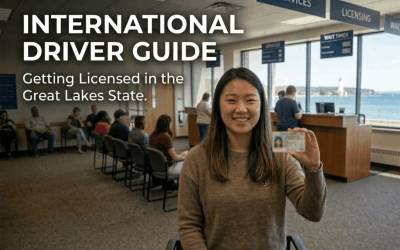

Moving to Michigan from another country brings the excitement of the Great Lakes and the Motor City, but it also brings the necessity of a valid driver’s license. If you are an international resident, student, or expat, navigating the Michigan Secretary of State (SOS) requirements is the first step to getting behind the wheel legally.
In Michigan, there is no “grace period” for new residents. Once you establish residency, such as starting a job, registering to vote, or enrolling in school, you must transfer your international driver license to Michigan immediately. Because Michigan does not offer a direct exchange for most foreign licenses, you will likely need to complete the full application process.
1. Check Your Eligibility and Residency
To qualify for a Michigan driver’s license, you do not need to be a U.S. citizen, but you must prove legal presence and Michigan residency. You are considered a resident if you live in the state and have at least two documents showing your local address.
According to the Michigan SOS New Resident guide, it is recommended to wait at least 10 to 14 days after arriving in the U.S. before applying. This delay allows federal databases (like the SAVE system) to update with your entry information, preventing unnecessary application denials.
2. Gather the Required Documents
The SOS requires original documents to verify your identity and status. Use the official SOS-428 Document Checklist to ensure you have:
- Proof of Social Security: Your Social Security card or a Letter of Ineligibility from the Social Security Administration if you are not eligible for an SSN.
- Proof of Legal Presence: A valid foreign passport with a U.S. visa and I-94, or a Permanent Resident Card.
- Proof of Identity: Your foreign passport or a valid Employment Authorization Document (EAD).
- Two Proofs of Residency: Original documents like a utility bill, bank statement, or lease agreement issued within the last 90 days.
3. The Testing Process: Knowledge and Vision
Unlike some states, Michigan requires most international applicants to pass the written knowledge test and a vision screening.
- Written Test: This exam covers Michigan traffic laws and road signs. You can prepare by studying the What Every Driver Must Know
- Reciprocity Exceptions: If you hold a valid license from South Korea, Germany, or Canada, you may be eligible for a waiver of the written and road tests due to specific reciprocity agreements with Michigan.
4. Temporary Instruction Permit (TIP) and Road Test
Once you pass the written test, you will receive a Temporary Instruction Permit (TIP).
- Practice Period: Normally, there is a mandatory 30-day practice period before you can take your driving skills test.
- Waiver for Experienced Drivers: If you provide your valid foreign driver license along with a certified English translation, the SOS can waive the 30-day waiting period, allowing you to take the road test immediately.
- Final Road Test: You must schedule your test with an authorized third-party testing organization. After passing, return to the SOS office with your skills test certificate to finalize your license.
Master the Roads of the Mitten State
Starting your journey as a driver in Michigan involves more than just passing a test; it is about adapting to a new environment. From the heavy snowfall of “Up North” winters to the unique traffic patterns like the “Michigan Left,” having a solid foundation in defensive driving is key to your safety and financial security.
To ensure you are fully prepared, all international residents are encouraged to complete the Michigan Basic Driver Improvement Course (BDIC). This state-approved, 4-hour online course is specifically designed to refresh your knowledge of Michigan traffic laws and teach you defensive strategies to avoid accidents. By completing the course voluntarily, you can often qualify for auto insurance discounts and, should you receive a minor traffic ticket in the future, use the course to keep points off your record. It is a simple, effective way to drive smarter and keep your insurance rates low while living in the Great Lakes State.